AWS Glue 6.0 General Availability Brings Major Performance Upgrades and Apache Iceberg v3 Support

AWS Glue 6.0 has officially entered general availability, marking a significant milestone for the serverless data integration service. This latest iteration introduces a modernized runtime environment, comprehensive support for the Apache Iceberg v3 specification, and a notable 30% reduction in pricing compared to its predecessor. By integrating Apache Spark 4.1, Python 3.13, and Scala 2.13, AWS aims to provide data engineers and architects with a more efficient, high-performance platform for managing large-scale extract, transform, and load (ETL) workflows.
Modernizing the Data Stack
The release of AWS Glue 6.0 is rooted in a broader industry shift toward open table formats and modernized compute runtimes. As organizations increasingly rely on data lakes for analytics and machine learning, the ability to manage semi-structured data without incurring excessive overhead has become a primary bottleneck.
The core of the upgrade lies in the transition to Apache Spark 4.1. This engine provides the foundation for the performance improvements seen in this release. By supporting the latest iterations of Python and Scala, AWS ensures that developers can utilize modern libraries and language features, reducing the technical debt often associated with legacy data pipelines. The integration of Iceberg 1.11.0, which powers the Iceberg v3 support, is particularly critical for enterprises dealing with evolving schemas and complex data structures.
The Impact of Apache Iceberg v3 and VARIANT Data Types
Perhaps the most anticipated feature of this release is the full implementation of the Apache Iceberg v3 specification, specifically the introduction of the VARIANT data type with shredding support. Historically, handling semi-structured data—such as JSON logs, sensor telemetry, or web events—required developers to flatten schemas or write complex, custom parsing logic. This often resulted in brittle pipelines that broke whenever a source system updated its data format.
With the VARIANT data type, AWS Glue 6.0 allows users to store and query semi-structured data natively. The shredding mechanism significantly enhances read performance by allowing the engine to access specific sub-fields without reading the entire record. By eliminating the need for duplicate data copies and complex schema-mapping code, data teams can expect a more resilient architecture that scales alongside growing data volumes. This shift represents a transition from "schema-on-read" challenges to a more manageable, native-data-handling model.

Strategic Pricing and Accessibility
In a market where cloud expenditure is under constant scrutiny, the 30% price reduction across all AWS Glue 6.0 instances is a strategic maneuver. By lowering the cost barrier, AWS is incentivizing users to migrate away from older versions of Glue and onto a faster, more cost-effective engine.
The billing model remains consistent with previous versions: users pay an hourly rate, billed by the second, for both crawlers and ETL jobs. The Data Catalog continues to follow a simplified monthly fee structure, with a free tier covering the first million objects stored and the first million access requests. This tiered pricing model is designed to support both small-scale experimentation and massive enterprise-level data warehousing.
Deployment and Migration Strategy
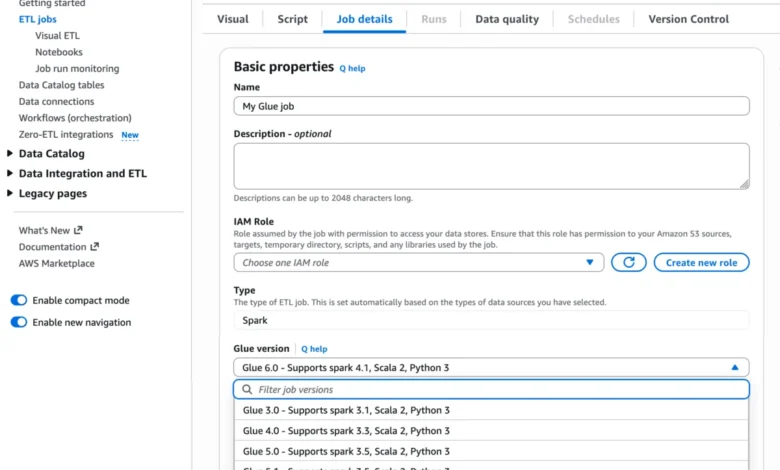
AWS has prioritized a frictionless transition for existing customers. No API changes are necessary to adopt the new version; administrators can simply update the --glue-version parameter in their existing create-job or update-job configurations. This compatibility extends to the AWS Command Line Interface (CLI), AWS SDKs, and the AWS Glue Studio interface.
For those managing complex environments, the AWS Glue Studio console now offers a streamlined path to upgrade. The platform includes a "Spark upgrade agent" designed to analyze existing jobs and highlight potential compatibility issues. Additionally, an auto-upgrade feature is available for jobs that do not require manual code changes, allowing organizations to transition to the new runtime with minimal downtime. For notebook users, the process is equally straightforward, requiring only a change to the %glue_version magic command in Jupyter or SageMaker Unified Studio environments.
Industry Context and Evolution
The trajectory of AWS Glue mirrors the evolution of the broader big data ecosystem. Since its inception, Glue has transitioned from a basic metadata catalog to a fully managed, serverless ETL service capable of running Spark at scale.
- 2017: AWS introduces Glue as a managed ETL service to simplify data preparation for Amazon S3 and Redshift.
- 2020-2022: Introduction of Glue DataBrew and Glue Elastic Views, expanding the platform’s utility to non-technical users and materialized view management.
- 2024: Deep integration with open table formats like Iceberg becomes a focal point as data lakehouse architectures gain dominance.
- 2026 (Present): Launch of Glue 6.0, prioritizing high-performance runtimes and native support for advanced schema-agnostic data types.
The decision to lean into Apache Iceberg is consistent with AWS’s commitment to open-source standards. By providing the most complete Iceberg v3 implementation on a serverless Spark platform, AWS is positioning itself to remain the primary choice for companies that prefer vendor-agnostic data formats over proprietary storage solutions.

Analytical Perspective: What This Means for Data Engineering
The release of AWS Glue 6.0 is likely to have two immediate effects on enterprise data operations. First, the performance gains from the updated runtime and the VARIANT shredding will likely reduce compute hours, further amplifying the cost savings provided by the 30% price reduction. Second, the reduction in maintenance overhead—specifically the avoidance of schema-change-induced pipeline failures—will allow data engineering teams to pivot their focus from "firefighting" broken pipelines to building value-add analytics.
Industry analysts observe that the move to Python 3.13 and Spark 4.1 also keeps AWS aligned with the fast-paced development cycles of the open-source community. By keeping the underlying engines current, AWS mitigates the risk of security vulnerabilities and performance degradation that often plague stagnant or "locked-in" managed services.
Global Availability and Support
AWS Glue 6.0 is currently available in all AWS Regions where the service is supported. Organizations looking to verify regional availability can utilize the AWS Capabilities by Region documentation. Furthermore, for teams integrating AI-assisted development into their workflows, AWS has made documentation and troubleshooting resources available through the AWS MCP Server and various plugins, allowing developers to query system requirements and migration guides using natural language processing tools.
As organizations grapple with the increasing complexity of data lakes, the move to Glue 6.0 serves as a reminder that infrastructure service providers are under pressure to provide not just compute power, but intelligent data abstraction. By automating the handling of semi-structured data and streamlining the migration path, AWS has signaled a clear intent to lower the barrier to entry for modern data engineering practices.
Feedback channels, including the AWS re:Post for Glue and standard AWS support contacts, remain open as users begin the migration process. For those managing mission-critical data pipelines, the recommendation is to utilize the Spark upgrade agent in a staging environment to validate performance benchmarks before rolling out the update to production workloads.